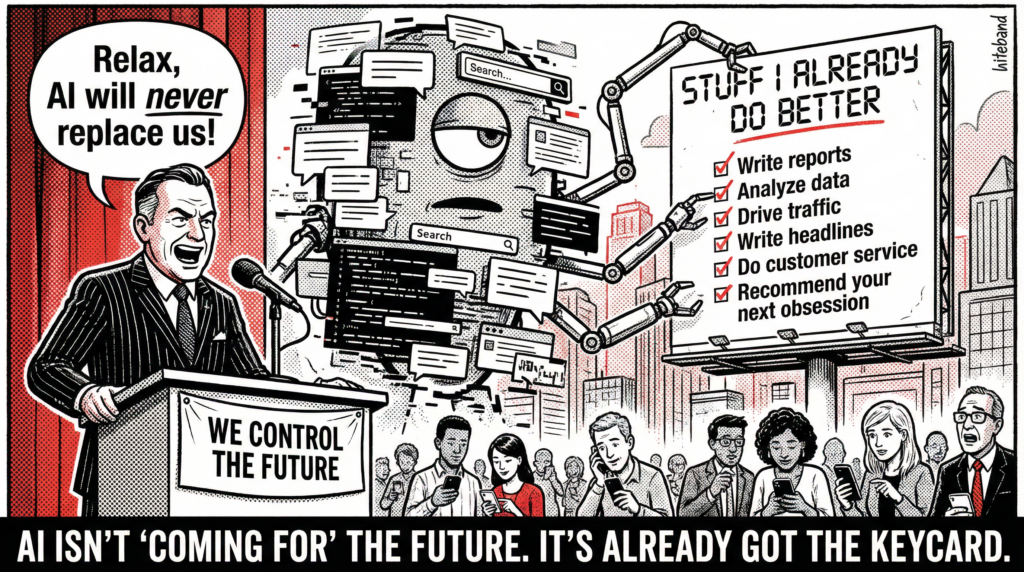
Let’s face it: AI has arrived, luggage in hand, wearing sunglasses indoors, and claiming it knows your vibes. It’s not leaving. It’s already rearranged your digital furniture, adjusted your playlists, and politely suggested you stop using Comic Sans.
Technologists cheer, artists grumble, and journalists… well, journalists are in the corner writing a think piece titled “Can We Trust the Machines to Be More Ethical Than Our Sponsors?” Meanwhile, AI just blinks and says, “Would you like that headline optimized for engagement?”
People keep calling it a “disruptor,” as though AI tripped over a power cord and ruined civilization’s Zoom meeting. It’s not a disruptor. It’s a mirror: one that doesn’t just show how we look, but what we search for at 2 a.m. It’s our collective consciousness with autocorrect.
Of course, there’s resistance. Every few weeks, a pundit announces that AI “can’t replace human creativity.” They’re right: it doesn’t need to replace creativity; it’s already in a group chat with it, trading memes and rewriting everyone’s résumés.
AI isn’t coming for your job; it’s coming for your inefficiencies. It wants to take over the boring parts so you can focus on catastrophically misusing the free time it gives you. Humanity’s greatest fear isn’t machine intelligence; it’s what happens when we’re forced to admit that maybe, just maybe, some parts of automation make sense.
So yes, AI is here to stay. It’s that colleague you didn’t hire but who keeps outperforming everyone and still asks if you’ve eaten lunch. The best move now? Learn to collaborate. Offer it coffee. Maybe don’t let it pick the playlist: it still thinks Nickelback is ironic.