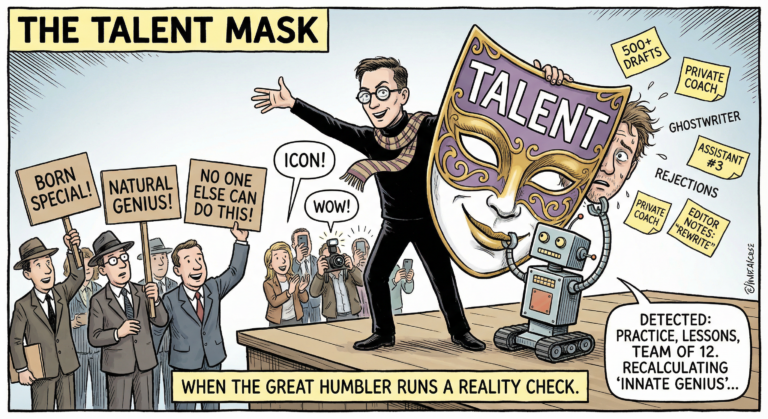
When technology strips away illusion, only integrity remains.
December 23, 2025.
The Mythology Is Over
For centuries, we’ve been sold a fairy tale: that talent is a kind of divine spark, born in some and withheld from others. Genius was mystified, protected, and marketed like a rare mineral. But AI has quietly killed that myth.
Artificial intelligence doesn’t “create” in the romantic sense. It automates. It disassembles artistic process into patterns, models, and data flows. What’s unnerving creatives isn’t that AI can paint, write, or compose; it’s that it reveals how much of what we called genius was just systematized labor. The curtain is gone. The show is exposed.
How the Genius Myth Was Built (and Sold)
The Renaissance humanized talent by detaching it from God and giving it a human face. By the Industrial Age, we’d turned “the artist” into commodity and brand. Copyright law enshrined artistic ownership, not as protection of creativity, but as protection of commerce.
The twentieth century perfected this mythology. PR firms and gallerists made sure that “genius” had a signature: Picasso’s chaos, Jobs’s precision, Koons’s kitsch, Hirst’s audacity. Behind each were unseen teams: technicians, engineers, draftsmen whose names never made it into the narrative. The mythology wasn’t an accident. It was marketing.
The Hidden Infrastructure
Artistic production has always depended on invisible ecosystems. Visual artists used ateliers filled with apprentices executing the master’s vision. Pop music runs on ghostwriters, session musicians, and producers who build the texture of “authenticity.”
Books are edited, polished, rewritten by teams of silent craftspeople. Even the lone auteur in film or tech depends on armies of specialists. Every medium has its ghosts. AI simply made them visible by functioning exactly like they always did, assembling, recombining, iterating, but doing so without the human veil.
When Creatives Bought Their Own Hype
The myth becomes most lethal when the artist starts believing it. When “talent” is framed as identity instead of discipline, self-reflection ends. Many creatives internalized the idea that their worth came from being unteachable, intuitive, inherently different.
So when AI started reproducing style, process, and form, many felt existentially violated. The outrage wasn’t about theft: it was about exposure. The machine proved what their egos refused to admit: genius is a practice, not an essence.
The STEM Blind Spot
For decades, the creative industries treated technology as an accessory, not a foundation. Programs like Photoshop, Logic, or Blender were tools to be “delegated,” not mastered. Meanwhile, the world quietly shifted.
Those who fused art with STEM, engineers who design, musicians who code, writers who understand algorithms, were already predicting this moment. The market was clear: hybrid skill sets became the currency. Yet too many ignored those signals, retreating into nostalgia for the analog age. The cost of that denial is now painfully visible.
Talent Was Always Work
Strip “talent” down and what remains are measurable systems: focus, pattern recognition, repetition, iterative improvement, and emotional calibration. AI exposes this by re-creating the visible results of those processes without the human sweat behind them.
The lesson isn’t that talent doesn’t exist: it’s that it was never mystical. The core differentiators are now critical thinking, aesthetic judgment, and systems literacy. Those are what machines can’t fake because they require perspective, not process.
What Creatives Do Now
The creative class can’t cling to mythology. They have to become transparent about their process and collaborators. Every artist today is part engineer, every engineer part artist. Learn enough technology to critique it. Learn enough science to shape it.
Treat AI like a lab partner: a collaborator that accelerates experimentation, not a specter of obsolescence. The artists who thrive will be those who stay curious about the “how” behind what they love, not just the “what.”
The Invitation
AI’s role is uncomfortable but necessary. It’s not here to kill creativity; it’s here to kill the illusion around it. It’s the great humbler of our age, confronting us with the truth we’ve long ignored: mastery is built, not born.
For those who accept that, this isn’t an ending: it’s an invitation. The mythology is collapsing. The work, the real work, can finally begin.
Afterthought: The Age of Earned Mastery
AI doesn’t erase human creativity: it erases the excuses around it. It’s the mirror that shows us whether our skills were rooted in method or mythology. For years, I’ve watched creatives defend mystique instead of method, charisma instead of craft. But now, the age of earned mastery is here.
At KlueIQ, I see this shift every day: where automation meets imagination, and process becomes the new mythology. The ones who thrive aren’t defending the past: they’re building the next vocabulary of art, inquiry, and design. The old script of genius doesn’t apply anymore. What comes next belongs to those who can read code as fluently as symbol, and truth as clearly as pattern.