
I. Institutional Pattern Blindness
The System's Sin: Not Making the File
Most true crime cases are about something going wrong inside the system: a bad investigation, a contaminated sample, a coerced confession. The Highway of Tears is about something different — a pattern of disappearances that was never formally recognized as a pattern by the institutions responsible for protecting the women involved.
Between 1969 and the early 2000s, Indigenous women and girls disappeared or were found murdered along a 724-kilometre stretch of Highway 16 in northern British Columbia. Each case was treated, by default, as an individual disappearance. No one in institutional authority connected them. No file for "connected Highway 16 cases" was created. The file didn't go missing. It was never made.
The reason was not a single corrupt officer or a catastrophic error. It was a cumulative, structural assumption: that missing Indigenous women were not a pattern worth naming. That they had probably left voluntarily. That they were high-risk, transient, difficult. The system's language for this is "no criminal element." The community's language for it is something else entirely.
It was the communities who named the pattern first — at a 1998 vigil in Terrace, British Columbia, where the phrase "Highway of Tears" was spoken aloud for the first time. It would be another seven years before the RCMP launched a formal investigation.
"We still don't know the true number of sisters who are missing. The exact number of women who have gone missing or been found murdered is unknown. The communities have been counting. The institutions have not."
— Carrier Sekani Family Services, Highway of Tears Initiative
II. The Route
724 Kilometres, No Bus Service
The geography of Highway 16 is inseparable from the pattern of disappearances. It passes through remote communities, First Nations reserves, and hundreds of kilometres of boreal wilderness. For decades, there was no public transit on this route. For Indigenous women without cars — living in poverty, moving between communities for work, education, or family — hitchhiking was the only option.
Highway 16 — Prince George to Prince Rupert, BC
George
hoof
Lake
Hazelton
Jctn
Rupert
Key communities marked in amber have documented disappearances or investigation significance. No public bus service existed on this route for decades — hitchhiking was the primary option for women without vehicles.
III. Trace the Pattern Yourself
The Timeline — Filter by Category
Below is a documented record of disappearances, murders, and institutional and community responses along Highway 16. Use the filters to show only victims, only institutional actions, or only community responses — and see how long the gap was between each.
Showing 29 of 29 events
IV. The Omission Engine
Six Ways the Pattern Stayed Invisible
The Highway of Tears was not invisible by accident. Six structural factors — each individually defensible, together catastrophic — kept the pattern from being formally recognized for decades.
V. The Community Named It
Before the RCMP Filed, Families Were Counting
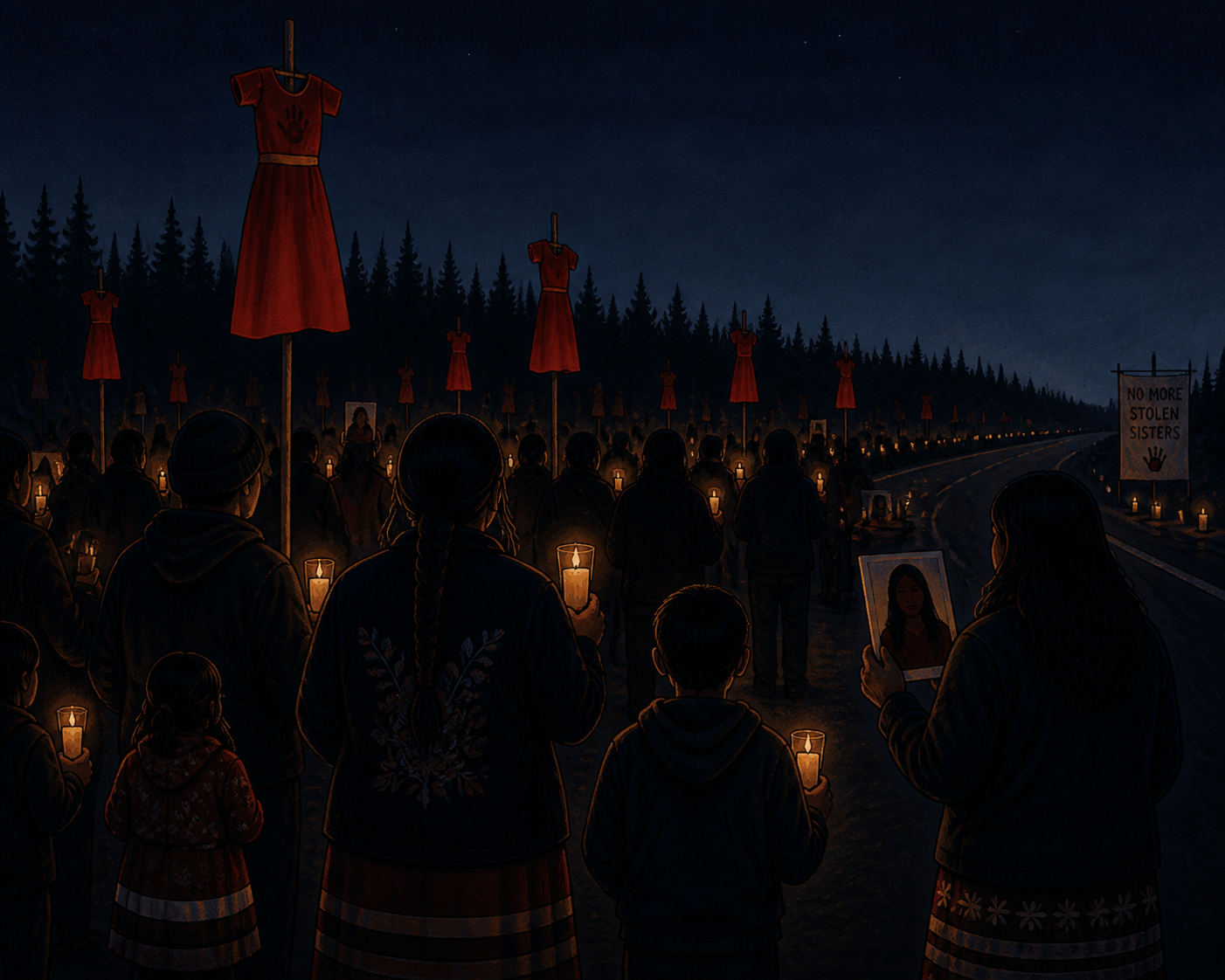
The families of the missing and murdered along Highway 16 did not wait for a formal investigation. For decades, they held vigils, kept their own records, traveled to each other's communities, and named their grief out loud when the institutions around them would not.
The name "Highway of Tears" was coined at a 1998 vigil in Terrace, BC — a community gathering to honour five women who had by then already disappeared. The phrase captured something that no police file had formally acknowledged: that this was not a series of unrelated tragedies. It was a pattern. And the communities had been living inside it for 30 years.
In 2006, families and community organizations formally organized. The Highway of Tears Symposium brought together more than 500 people — and produced 33 concrete recommendations. This was not a lament. It was a programme of action, built by people who understood the infrastructure of the problem from the inside.
The RCMP launched Project E-PANA in 2005 — one year before the Symposium — but community advocates argue that the formal recognition came because communities had been loudly naming the pattern for years, not because institutions identified it independently.
VI. The Number Dispute
18, or 40+, or We Don't Know
The gap between official and community counts is not a clerical disagreement. It is the core evidence of institutional pattern blindness. Whose count defines the crisis? Whose criteria set the threshold for intervention?
The criteria that define an "official" victim are not neutral. Geographic boundaries, date ranges, and evidentiary standards — all set by the institution doing the counting — determine what counts as part of the pattern. When those criteria exclude cases the community knows about, the official count understates the scale and reduces the political urgency of response. The RCMP's 18 is not wrong. It is incomplete. And the incompleteness is the omission.
VII. What Institutional Pattern Blindness Looks Like
The Sins of Omission
Institutional pattern blindness is not incompetence in the ordinary sense. It is the systematic failure to connect dots that the institution has structurally separated — by jurisdiction, by classification, by assumption, by indifference.
In the Highway of Tears case, the omission was not a single decision. It was a habitual non-decision: the daily choice not to treat these disappearances as connected, not to cross-reference cases, not to build the file that would have made the pattern visible.
The National Inquiry into Missing and Murdered Indigenous Women and Girls used a specific word for what happened: genocide. Not a metaphor. A legal and historical designation for what occurs when a state — through action and inaction — allows the elimination of members of a group to continue, and fails to protect them because of who they are.
VIII. The 33 Recommendations
What Was Asked in 2006, What Was Delivered
In 2006, the community produced a formal action plan. Twenty years later, the scorecard is stark.
The Pattern Was Always There
The Highway of Tears is not a cold case. It is an ongoing crisis. Women and girls continue to go missing along Highway 16 and across British Columbia, and their cases — where no task force criterion connects them to E-PANA — are processed as individual files by the same institutional architecture that missed the pattern the first time.
The communities named it. The families counted. The 2006 Symposium produced a roadmap. The 2019 National Inquiry named it genocide. What the system produced, for decades, was absence — the absence of a file, the absence of a connection, the absence of urgency. That absence is the sin of omission.
Trace the pattern yourself. Look at the timeline above. Count the years between the first disappearance and the first task force. Count the years between the Symposium recommendations and the first cell tower. Then ask: what does the system need to see before it sees a pattern?
- Highway of Tears Initiative · Carrier Sekani Family Services: highwayoftears.org
- RCMP Project E-PANA tip line: 1-877-543-4822
- Families of Sisters in Spirit (FILU) BC: 1-888-355-0064
- MMIW National Inquiry Final Report: "Reclaiming Power and Place" — 231 Calls for Justice (2019)
- Human Rights Watch Report (2013): "Those Who Take Us Away" — hrw.org
- Highway of Tears Symposium Recommendations Report (2006/2013) — available at highwayoftears.org