An artist's studio in shadow — empty chair facing the light, bookshelves in the background

The Human File

Alexander
Sasha
Merman

Teacher · Artist · Marine · Son · 1972 – 2008

Before he was a case number, he was a man who taught children how to see.

Born Russia, c. 1972
Died March 18, 2008
Location Santa Monica, CA
Episode Season 1 · Ep. 5

Who Sasha Was

Alexander Merman — known to everyone as Sasha — was the kind of person who carried multiple worlds at once: the immigrant who earned citizenship, the Marine who became a pacifist, the man with an inheritance who chose a teacher's salary anyway.

Sasha was born in Russia and immigrated to the United States, where he eventually served in the Marine Corps before building a life in Los Angeles. He was educated, intellectually curious, and deeply invested in the arts — not as a hobby, but as a vocation.

He taught art and music at Markham Middle School in Watts, one of the most under-resourced neighbourhoods in Los Angeles. He worked with students who had little access to the arts, and he showed up for them. He lived modestly on a teacher's salary, even after inheriting his condominium and over $300,000 from his uncle.

That inheritance would become a fatal vulnerability. But it was never who he was. It was only what made him a target.

01
Russian-born immigrantBuilt a new life in Los Angeles through military service and education
02
United States MarineServed before transitioning to a career in arts education
03
Art & Music TeacherTaught at Markham Middle School in Watts, Los Angeles
04
Surrealist PainterWork exhibited in New York galleries; art was not incidental — it was central
05
Son of SophiaHis mother's calls, unanswered on March 19th, are how the world first knew something was wrong
He lived modestly on a teacher's salary. The condo was inherited. The money was inherited. The trust that someone would take care of it — that was earned, and then betrayed.
True Crime, Wrong Story · Season 1, Episode 5

Markham Middle School, Watts

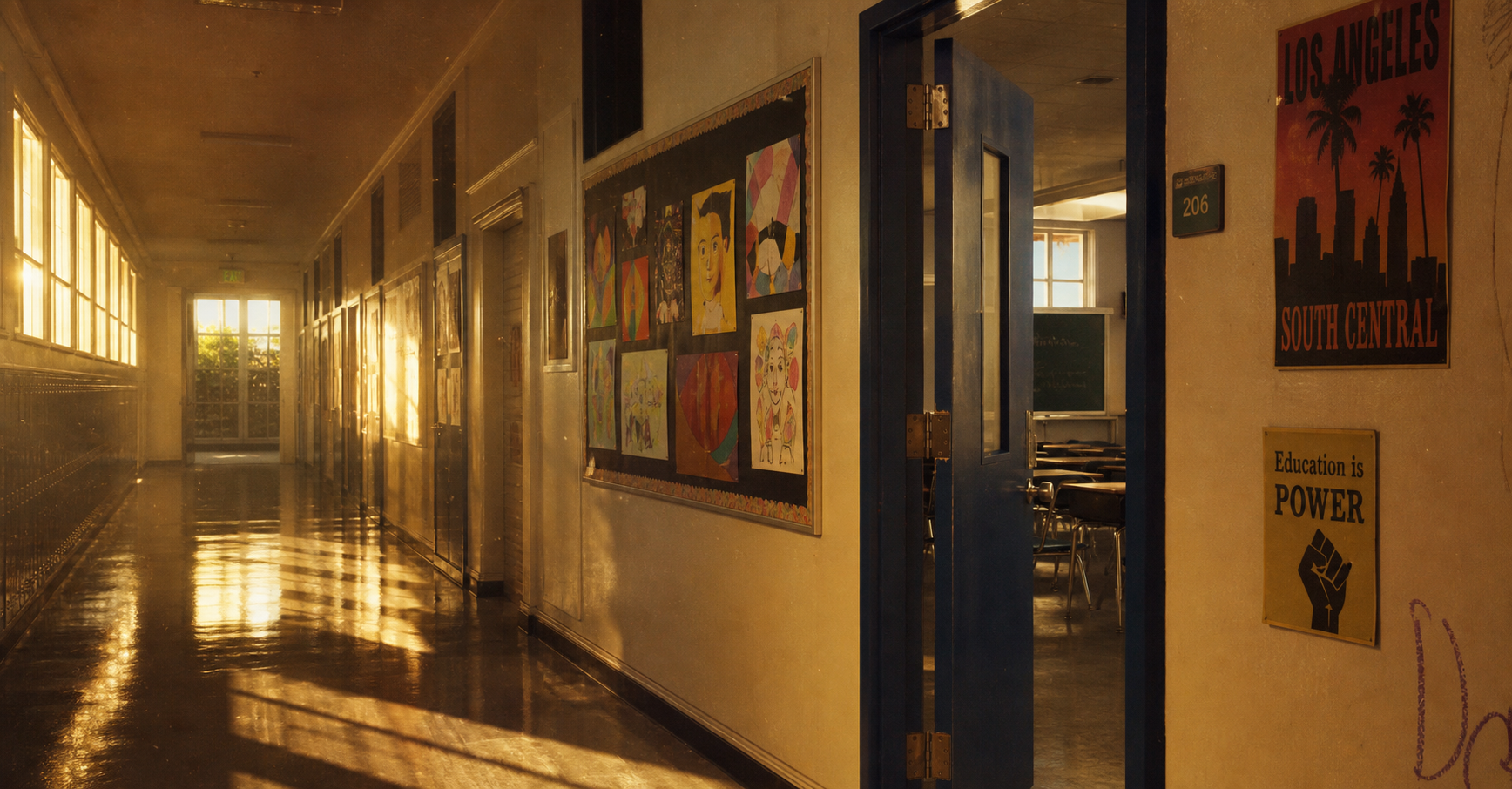
Sunlit school corridor in South Los Angeles — afternoon light, student artwork on the walls
South Los Angeles · A classroom like Sasha's

Markham Middle School sits in Watts — a neighbourhood that does not appear often in the version of Los Angeles that gets celebrated. Sasha chose to work there.

He taught art and music to children who rarely saw either treated as serious subjects. He brought the aesthetics of surrealism, of movement, of creative expression into rooms that had very little of it. His work was not aspirational performance. It was a daily practice of showing up and making room for imagination in a place where imagination was not guaranteed.

That choice is worth naming. He could have moved into a different career after his inheritance. Instead, he kept teaching.

520 Montana Avenue, Santa Monica His inherited condominium, where he was found on the evening of March 19, 2008. The gap between Watts and Santa Monica was part of his life — the teaching self and the private self, the modest income and the modest apartment that his family gave him.

Surrealist Painter, New York Galleries

Surrealist illustration: floating books, classroom doorway opening into open sky, paint-stained hands

Sasha was a surrealist painter. Not a hobbyist, not a weekend artist — his work was serious enough to be shown in galleries in New York. He made things that were strange, and structured, and alive in a way that realistic painting rarely achieves.

Surrealism is the art of the irrational made visible — dream logic rendered with discipline. That his paintings found an audience in New York while he remained teaching in Watts tells you something about the quality of the work and the character of the man. He did not pursue visibility for its own sake. He made his art and gave his labour where it was needed.

In a case defined by questions about time, evidence, and the machinery of justice, Sasha's paintings are a reminder that a person's inner life does not reduce to motive and timeline. He had a way of seeing that no coroner's report documents.

Surrealism New York exhibitions Art educator Music educator Visual artist Self-taught composition

The Adviser, the Schemes

He inherited money he did not need to flaunt, and trusted a man who used that trust as a mechanism of theft. The betrayal was years in the making before it became the motive for murder.

In 2004, Sasha attended an investment presentation given by Daniel Becerril, who introduced himself as a financial adviser. Sasha had recently inherited his uncle's condominium at 520 Montana Avenue and over $300,000. He needed someone to help manage it. Becerril offered to do so, and the two became — or appeared to become — friends.

Behind the relationship, Becerril was running an extensive fraud operation through his company, AP Financial Group, based in Huntington Beach. Pyramid schemes. Retirement account fraud. Mortgage fraud. The estimated total losses to all his victims ran into the millions.

From Sasha specifically, Becerril stole more than $300,000 and owed him over $550,000 in total. By March 2008, Sasha had discovered the theft. He had receipts. He had bank statements. He had proof. He was going to report it. The money was gone — and Becerril knew it.

2004
The introduction. Becerril presents at an educator investment event. Sasha, newly inheriting $300,000+, seeks financial guidance. Becerril becomes his adviser.
2004 – 2008
Friendship and theft. The two socialise. Becerril continues operating AP Financial Group — pyramid schemes, retirement fraud, mortgage fraud. Sasha's accounts are being drained without his knowledge.
March 2008
Discovery. Sasha finds the evidence. He has receipts, bank statements, proof. Becerril owes him over $550,000 and cannot repay. Sasha intends to report him to authorities.
March 18, 2008
The last morning. Sasha uses his phone at 12:40 p.m. After that moment, he never answers another call, and never sends another message.

March 18, 2008 — Santa Monica

What we know of Sasha's last day is fragmentary by design — the case would hinge on forensic attempts to reconstruct the hours no one witnessed. What follows is what the record offers.

Morning
Sasha is at home
At his condominium, 520 Montana Avenue, Santa Monica. Nothing in the record suggests anything unusual about the morning.
12:40 p.m.
Last confirmed contact
Sasha uses his cell phone. This is the last record of him alive. At the same time, Becerril's phone pings near the condo — the critical overlap the prosecution would later try to establish as the murder window.
That evening
No answer
Sasha does not show up to work. His mother Sophia calls. He does not answer. She asks the building manager to check on him.
Discovery
Found in his apartment
The building manager finds Sasha. He has been stabbed seven times in the back of the head and neck. A blood-soaked towel partially covers his face. His cell phone is missing. Papers have been burned in the fireplace. He has defensive wounds on his hands.
No physical evidence
Nothing useful remains
No fingerprints. No DNA. No murder weapon. No eyewitness. No forced entry. The only investigative thread is motive — and motive requires time of death. The case now belongs to forensics.

More Than a Life

A murder case tends to catalogue losses in the language of evidence — the weapon not found, the phone not recovered. This section names a different set of losses.

Taken
The Remaining Work
Every painting not yet made. Every student not yet taught. Sasha's surrealist practice was still developing when he was killed at 35. What a painter makes in the years of his full maturity is unknowable now.
Taken
Sophia's Son
His mother called. He did not answer. The building manager was sent because a mother's instinct is not nothing. That relationship — its history, its specific weight — is among the things no case record documents.
Taken
Authorship of His Own Story
Once you are a murder victim, the story of your life is told backwards — from the crime scene forward. Sasha does not get to narrate himself. He is reconstructed from evidence, cell ping records, and the version of him that serves a prosecution.
Taken
The Chance to Testify
He had receipts. He had bank statements. He had proof. He was, by all indications, about to report Becerril to authorities. What he knew — and what he would have said — died with him.
Taken
His Own Certainty
Ironically, the case that bears Sasha's name is remembered primarily because the time of his death became uncertain evidence. His death became a forensic puzzle. What was never uncertain is that he deserved better than this.
Taken
A Clear Public Record
The plea deal ended the public testing of the evidence. There is no trial transcript. No cross-examined expert testimony. For anyone who comes looking later, the record gives them a sentence — not a story.

The official story says the case was solved. The plea was entered. The sentence was served. What this dossier insists is that Sasha Merman — teacher, painter, Marine, son — was not simply the hinge point of a forensic argument about body temperature. He was a person. He still is one.

Case Record & Sources

Case identifiers
Case numberBA 394601
Date of deathMarch 18, 2008
Location520 Montana Ave, Santa Monica, CA
Manner of deathHomicide
Cause of deathStab wounds (seven), head and neck
ConvictionDaniel Becerril · No contest plea, 2014
Sentence15 years, voluntary manslaughter + fraud
Restitution$315,000 to Sasha's family
Person record
Full nameAlexander Merman
Known asSasha
Bornc. 1972, Russia
Age at death35
OccupationArt & Music Teacher
SchoolMarkham Middle School, Watts, LA
Military serviceUnited States Marine Corps
Artistic practiceSurrealist painter; exhibited in New York
Sources & Further Reading: California Sunday Magazine (investigative profile of the Becerril case and Erin Morris's forensic challenge) · LA Times Homicide Report (Alexander Merman entry) · Santa Monica Police Department records (Becerril sentencing, 2014) · True Crime, Wrong Story, Season 1, Episode 5: "The Price of Certainty" · This dossier is produced as a companion document to the TCWS broadcast episode and is intended for educational and journalistic purposes.