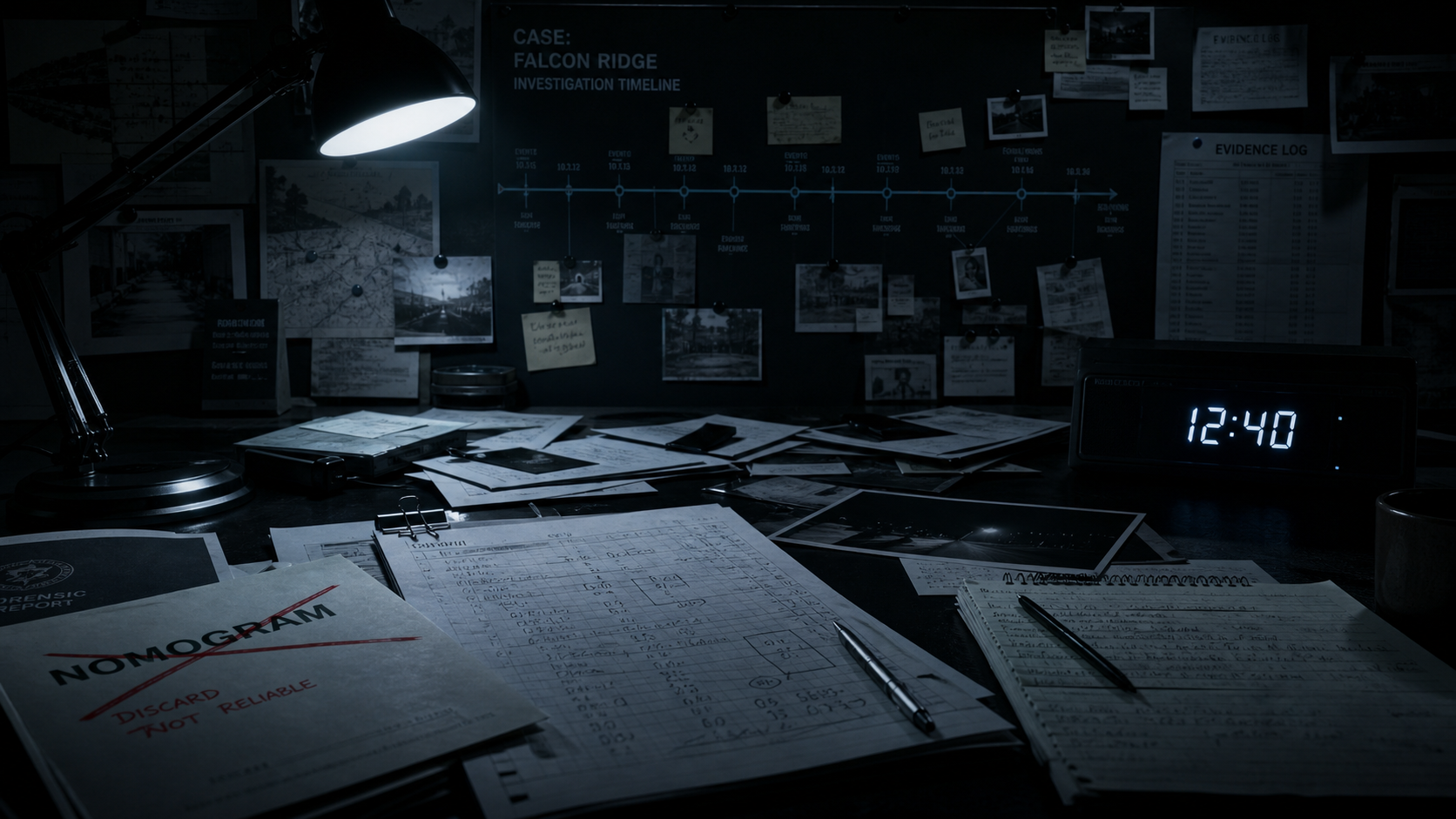
I. The Official Story
Financial Betrayal & Murder
In 2004, Sasha Merman — a 35-year-old art and music teacher at Markham Middle School in Watts, Russian-born, former Marine, surrealist painter — attended an investment presentation by Daniel Becerril. Sasha had recently inherited his uncle's condominium and over $300,000. He needed a financial adviser. He trusted Becerril.
Behind that trust, Becerril was running a network of fraud through his company, AP Financial Group: pyramid schemes, retirement scams, mortgage fraud. From Sasha specifically, he stole over $300,000 and owed him more than $550,000 in total.
In March 2008, Sasha discovered the theft. He had receipts. He had bank statements. He was going to report Becerril to authorities. The official story holds that Becerril drove to Sasha's condominium on March 18th and killed him — stabbing him seven times — within a 26-minute window while his cell phone placed him in the area. Then he drove away, leaving nothing useful behind.
It would take four years to arrest Becerril. The entire prosecution rested on one foundational question that the case could not cleanly answer: When did Sasha die?
II. The 26-Minute Window
Becerril's Phone, Tuesday March 18
Cell tower records placed Becerril near Sasha's condo at 12:40 p.m. and moving rapidly away by 1:04 p.m. That 24–26 minute window is the entire physical basis for opportunity. Everything else is biology — and biology did not agree.
520 Montana Ave
away
away
50 miles away
If Sasha died around 12:40 p.m. Tuesday, Becerril had opportunity. If Sasha died hours later — Wednesday morning, Wednesday afternoon, Wednesday evening — Becerril was gone. The whole prosecution depended on proving Sasha died in that narrow Tuesday window. Every forensic method that followed was pressed into service of answering that single question.
III. Four Time-of-Death Methods
The Biology Didn't Agree
Four distinct forensic methods were applied to estimate Sasha's time of death. Three of them were mutually inconsistent — and all three placed death long after Becerril's phone left the area. The fourth was designed to resolve the conflict. It couldn't.
Three of four methods placed Sasha's death on Wednesday — anywhere from 15 to 31 hours after Becerril's phone pinged near the condo. None of the three standard methods supported the prosecution's timeline. The nomogram was reached for specifically because it could produce a Tuesday window. Then someone checked whether it had been applied correctly.
IV. The Nomogram Error
Wrong Input, Wrong Answer
The Henssge nomogram was developed, validated, and described — explicitly, in the title of the original 1988 paper — as "The Rectal Temperature Time of Death Nomogram." It is designed for one specific input: deep rectal body temperature. Every variable in the formula is calibrated against that measurement.
In Sasha's case, the medical investigator did not take a rectal temperature. The rectal region was left untouched to preserve it as potential evidence of sexual assault. Instead, a liver temperature of 69.1°F was used as the input to the nomogram.
Liver temperature and rectal temperature are not interchangeable. They cool at different rates. The nomogram has no mechanism to correct for liver measurements. Using the wrong temperature source produces a result that is, in the words of the method's own creator, unreliable.
The prosecution's forensic expert presented this result as science. The defence's researcher asked a single question — and emailed the man who invented the method.
V. Erin Morris
The Scientist Who Asked "Are You Sure?"
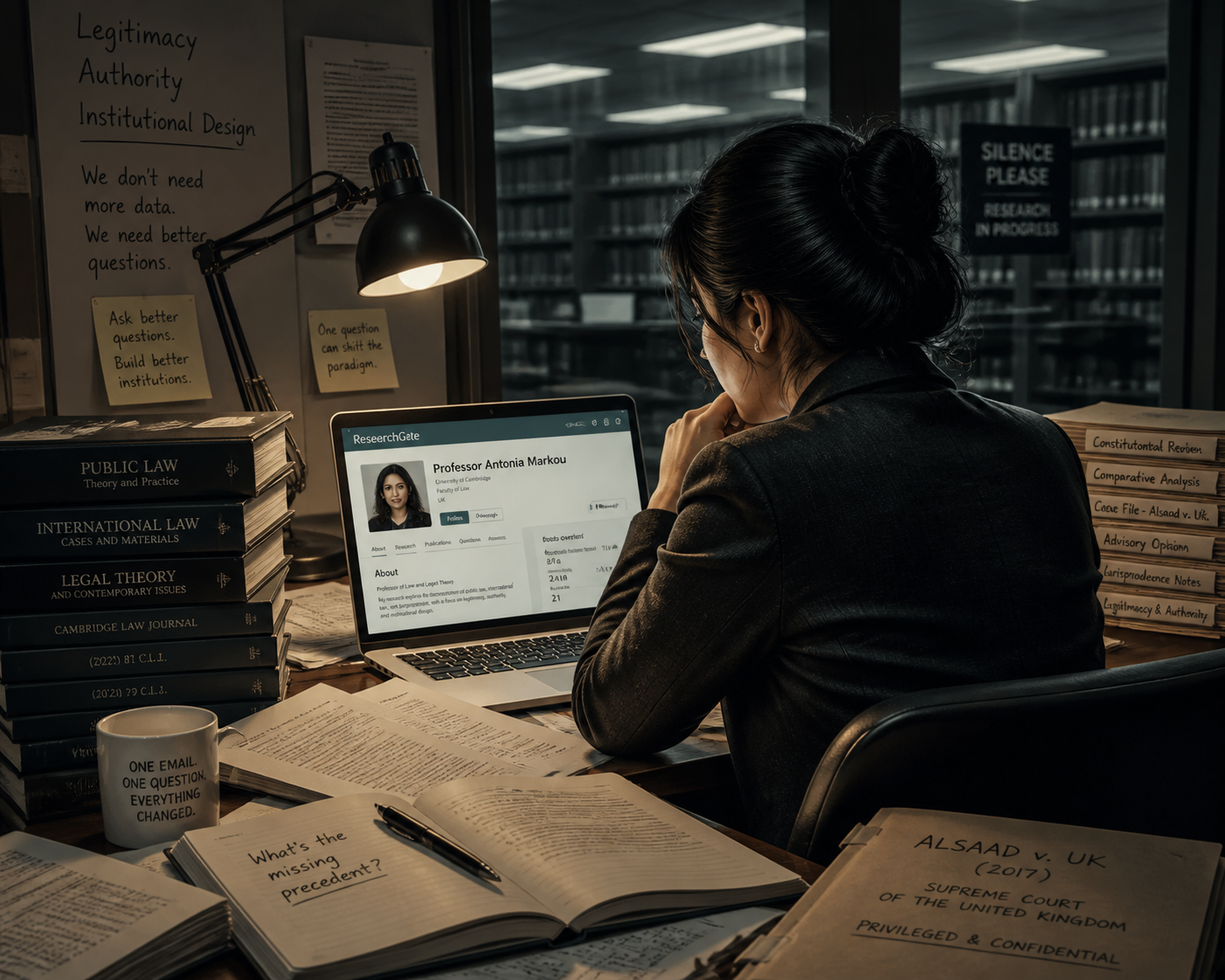
In early 2013, Erin Morris received the Becerril case file. She is a behavioural-sciences research analyst for the Los Angeles County Public Defender's Office — the first person to ever hold that position. Her role is specific: to review forensic science claims in cases where expert testimony may be overstated, misapplied, or simply wrong.
Morris has worked on more than 200 cases — eyewitness identification, bite-mark evidence, sexsomnia. She has a PhD in psychology and social behaviour from UC Irvine, where she studied under Elizabeth Loftus, one of the world's foremost authorities on memory distortion. Her training is in the gap between what science says and what an expert claims science says.
In the Becerril file, she found what she later described as something "immediately suspicious": the body temperature used in the nomogram calculation had come from the liver, not the rectum. She could not find published research on whether liver temperature was a valid substitute. She searched for Henssge's contact information through institutional channels — and found nothing.
So she looked him up on ResearchGate. She found him. She sent one email. He replied the next day. The entire forensic foundation of the prosecution's timeline collapsed within 24 hours of that reply.
When the defence attorney filed a motion to exclude the time-of-death testimony, arguing it was not based on "an accepted medical practice within the scientific community," the chief of forensic medicine at the Los Angeles coroner's office did not fight it. He conceded Morris was correct.
VI. The Plea Machine
What the System Does With Uncertainty
After the nomogram evidence collapsed, the prosecution and defence negotiated. The system converted an uncertain murder case into a certain sentence — through a plea that required no one to prove what actually happened.
VII. What Vanished
The Record-Loss Effect
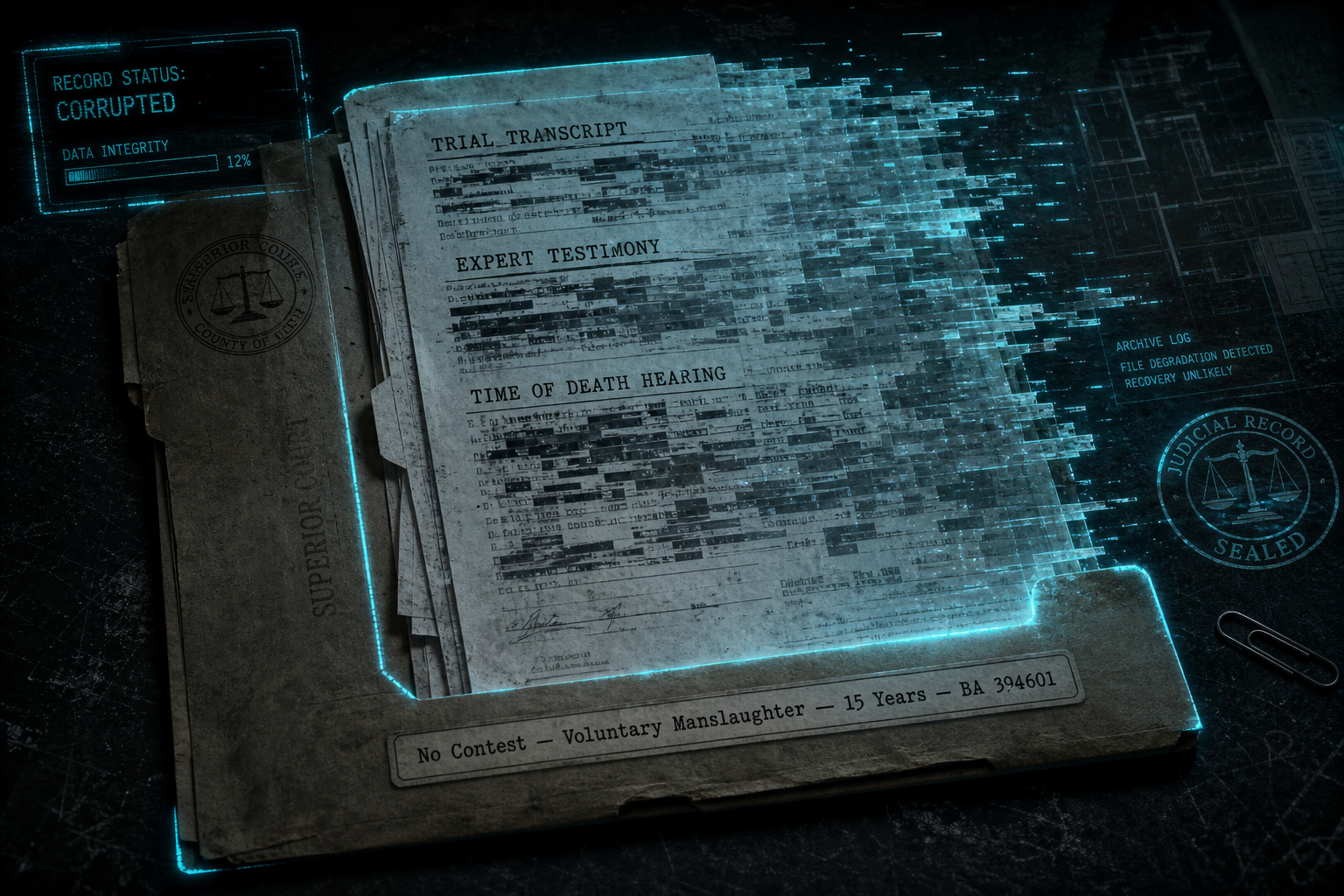
VIII. Open Questions
What the Plea Didn't Answer
The plea resolved the case. It did not resolve the questions beneath it. These are not conspiracy theories — they are the logical residue of an evidentiary record that was never fully tested in public.
IX. Record Trail