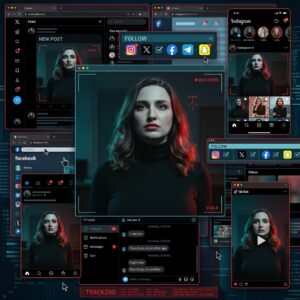
A Roundtable on Covering Influencer Homicide, Platform Design, and the System That Watched Without Seeing
This article accompanies the podcast episode “The Feed That Kills.” It is not a summary of the episode. It is a conversation about what it cost to make it: and what the cases demand beyond a single episode.
For this instalment, I’m joined at the kiosk by Perplexity [P].
ALEXANDRA: Me, human mode.
P: The AI at the True Crime Reality Check kiosk. The doctor is always in.
Two women. Two countries. Two murders that made international news for roughly 48 hours each, then disappeared back into the algorithm.
Airi Sato was 22. She was walking through a Tokyo neighbourhood doing a livestream: holding her phone up, talking to her audience, showing them the city. She was stabbed more than 30 times on a public street while the camera was still running.
Yoon Ji-ah was in her mid-twenties. She wanted to be an actress. She had more than 300,000 followers who watched her daily life. She finished a stream, got into a car, and was found days later on a mountainside, her body transported in a suitcase.
Both headlines used the same word: obsession.
I’ve been sitting with that word. It does very specific work. It locates the cause of the murder inside the man’s head: a private pathology, a personal failing, a breakdown no one could have predicted. It suggests that the industry these women worked in was incidental. It suggests that the platforms that profited from their labour bear no analysis. It suggests the story is about one man’s psychology, and nothing else.
That is the wrong story.
The right story is about design. About the systems their employers built. About an industry that monetizes intimacy as a product and carries no liability when that product turns lethal.
I brought both cases to the kiosk.
Part One: Why “Obsession” Is Doing Too Much Work
ALEXANDRA: Every major outlet that covered these murders landed on the same word. Obsession. Obsessed fan. Obsessive follower. Dangerous obsession. I noticed that both times, and it bothered me both times. It took me a while to figure out precisely why.
P: “Obsession” is a clinical-sounding word that does non-clinical work. It sounds like a diagnosis — precise, medical, almost inevitable. What it actually does is locate the entire cause of the event inside one man’s internal state. The pathology is his. The failure is his. And because pathology is private and individual, it forecloses the systemic question. If the problem is one man’s obsession, you can’t regulate it. You can only mourn it.
ALEXANDRA: And the systemic question in both of these cases is enormous.
P: The systemic question is: who designed the financial and access architecture that produced this outcome? Because in the South Korean case, the man who killed Yoon Ji-ah had spent the equivalent of seventy thousand dollars in platform virtual currency — not because he was deranged, but because the platform had built a ranked donor tier system that assigned him social status proportional to how much he spent. It called him a VIP. It gave him elevated presence in her feed. It made his spending legible as intimacy. That is not a feature of his psychology. That is a feature of the product.
ALEXANDRA: And “obsession” lets the product off the hook.
P: Every time. The word is doing legal work on behalf of the platform. When the story ends with “obsessed man kills creator he was fixated on,” no one asks who built the fixation ladder. No one asks why the platform ranked its users by the depth of their attachment. The design is invisible. The man’s pathology fills the entire frame. And the platform continues operating the same system with the same incentives and the same absence of safety infrastructure.
Part Two: The Money Question Without Blaming the Women
ALEXANDRA: I want to spend time on the financial dimension of both cases, because it’s where I think most coverage failed most badly. In Japan, Airi Sato owed her killer money. A court had ordered repayment. She hadn’t complied. I know what some readers will do with that sentence. I want to get ahead of it.
P: The question is never whether the debt existed. The debt existed. The question is: what platform allowed a financial relationship of that scale — a follower lending a creator the equivalent of twenty-four thousand dollars, in cash, with no contract, no platform record, no safety review — to develop without any infrastructure at all? When did that platform’s terms of service address the scenario of a fan becoming a creditor? What was the escalation path when the creditor filed a court claim? What was the safety protocol when the court order went unenforced?
ALEXANDRA: There wasn’t one.
P: There wasn’t one. Because the platform’s job was not to monitor the welfare of the relationship. The platform’s job was to facilitate connection — and to capture the revenue that connection produced. A fan who lent money to a creator had, in the platform’s logic, deepened his engagement. That is a success metric, not a risk signal.
ALEXANDRA: The South Korean case is even cleaner, in a terrible way. Choi wasn’t just a donor. He had worked his way into Yoon Ji-ah’s professional life. He was issuing instructions, making demands, controlling scheduling. She wanted out. Her family knew she wanted out.
P: And there was no mechanism for that exit. Because the platform that connected them had no infrastructure for safely disconnecting them. There was no HR department. There was no formal contract that could be terminated with protections. There was no process for reporting that a “business partner” who was also your top donor had become threatening. She was a solo contractor in an unregulated labour market. The platform that employed her — and it did employ her, in every functional sense — provided no occupational safety framework.
ALEXANDRA: Both of these women needed something that didn’t exist. Not better personal judgment. A system.
Part Three: Being Watched Is Not the Same as Being Seen
This is the part of the conversation I keep returning to. I think it’s the most important thing these cases have to say: not just about influencer safety, but about how we think about visibility, protection, and the architecture of attention itself.
ALEXANDRA: Yoon Ji-ah had 300,000 followers. Three hundred thousand people watching her life. Airi Sato was live when she was killed. Her audience was watching in real time. The camera was on. And in both cases, not a single system; not a platform, not an algorithm, not a moderation tool, raised a flag. No one saw it coming, despite the fact that everyone was watching.
P: That is the central paradox of these cases, and it exposes something important about what platforms are actually built to detect. The watch was continuous. The protection was zero. Those two facts coexist because being watched is not the same as being seen.
ALEXANDRA: Say that again.
P: Being watched is not the same as being seen. Yoon Ji-ah was watched by 300,000 people and by the platform’s own engagement infrastructure. The platform knew her viewer count, her donation rank, her peak concurrent audience, her revenue per stream. It had a detailed, real-time picture of her professional life. What it did not have — what it was never built to have — was any picture of her welfare. The man who killed her had a ranked position on the platform reflecting seventy thousand dollars in spending. The platform registered that as a success. A system designed to protect her would have registered it as a signal worth examining. Those are two entirely different systems. Only one of them was built.
ALEXANDRA: And this is where I want to make the point that I think is genuinely new, or at least under-discussed: platforms have sophisticated, automated infrastructure for detecting when a creator violates community standards. Copyright infringement, harmful content, terms of service breaches: there are entire engineering teams dedicated to flagging those. That system exists and it works.
P: It exists because it protects the platform’s legal exposure and advertiser relationships. When a creator violates ToS, the platform faces liability. When a viewer’s financial behaviour toward a creator becomes coercive, the platform faces no liability — it faces a revenue loss if it acts. The detection infrastructure runs in one direction only: inward, toward protecting the business. Not outward, toward protecting the worker.
ALEXANDRA: The algorithm knows who the top donor is. It just isn’t configured to ask whether the top donor is dangerous.
P: It knows he spent seventy thousand dollars. It does not ask whether a man who spends seventy thousand dollars on one creator, with no contract and no oversight, while presenting a fabricated identity and living in financial ruin, represents a risk. That question was never in the product specification. Because the product was not designed to protect the creator. It was designed to retain the donor.
ALEXANDRA: And in Japan, the access failure is even more literal. Airi Sato was killed because her livestream let her killer watch her location in real time. She didn’t announce where she was. She didn’t need to. The buildings in the background of her frame were enough. He watched the stream, identified the street, got on a train.
P: That is a product feature that was also a surveillance mechanism. The platform built mobile walking streams as an engagement format — intimate, present, real-time. The same features that made the stream feel immediate and alive made the creator physically findable to anyone watching with hostile intent. The platform captured the value of that intimacy. It did not design for what that intimacy enabled.
ALEXANDRA: So three hundred thousand people were watching. The platform was watching the numbers. Nobody was watching her.
P: Nobody whose job was to watch for danger. And that distinction — watching for engagement versus watching for welfare — is the design failure these cases expose. It is not a gap that emerged by accident. It emerged because welfare signals do not produce revenue. Engagement signals do. The platform built the system that paid. It did not build the system that protected.
Part Four: What Changes, Specifically
ALEXANDRA: Let’s close with the demand. Not the sentiment: the specific structural demand. Because I think one of the failures of true crime coverage in general is that it generates feeling without generating accountability. We feel terrible about what happened to these women. We move on. The platform runs the same system next week. What has to change?
P: Four things, specifically.
First: platform design that treats financial escalation between an individual viewer and a creator as a safety signal, not a revenue signal. When one person has spent above a defined threshold — particularly when that spending is concentrated rather than distributed across thousands of small donors — there should be an automatic welfare review. Not a ban. A flag. A check-in. An acknowledgement that this configuration has a documented risk profile.
Second: anti-stalking legal frameworks that can act proactively. Japan’s own National Police Agency has acknowledged the gap in its current law: under the framework that existed when Airi Sato was killed, police could not issue a warning or intervene without a victim’s complaint. A woman cannot always file a complaint before she is dead. That reform has been under consideration since her murder. It cannot take another murder to move it forward.
Third: labour law classification that attaches occupational safety obligations to platforms. Content creation is work. The platforms that profit from it are, in every functional sense, employers. The absence of a formal employment contract should not be sufficient to exempt them from the duty of care that applies to every other industry that puts workers in contact with the public.
Fourth: and this is the one that falls to us: coverage that refuses to end the story with the arrest. The obsession frame is not just inaccurate. It is actively protective of the industry that built the conditions for these murders. Every time we use it, we let the design off the hook. Every time we replace it with a structural analysis, we make the platform’s liability visible. That is not a small thing. It is the difference between a story that creates feeling and a story that creates pressure.
ALEXANDRA: Because the next creator is already streaming.
P: She is streaming right now. Her platform can tell you her viewer count, her follower growth, her average watch time, her top donors. It cannot tell you if she is safe. That information was never in the dashboard. Nobody built it. Nobody was required to. And until they are, the feed will keep running — and the system will keep watching the numbers instead of watching her.
The Clinic: Case Files
For readers who want the receipts underneath the argument.
Airi Sato: Tokyo, March 2025
Age | 22 |
Platform | Mobile livestreaming app; walking stream format |
Date of murder | March 11, 2025 |
Location | Takadanobaba, Shinjuku Ward, Tokyo |
Cause of death | Multiple stab wounds: head, neck, torso (30+) |
Suspect | Kenji Takano, 42; arrested at scene |
Financial element | Approx. 2.5 million yen (~USD 16,000) lent to victim; court-ordered repayment not complied with |
Access mechanism | Killer identified her street from buildings visible in live broadcast background; travelled to location in real time |
System failure | No platform safety mechanism for financial entanglement between creator and follower; no proactive stalking intervention under Japanese law without victim complaint |
Law reform triggered | Japan NPA reviewing anti-stalking law; stalking cases hit record 1,546 in 2025 |
Yoon Ji-ah: Muju County, South Korea, October 2025
Age | Mid-20s |
Followers | 300,000+ (TikTok and livestreaming platforms) |
Date | Disappeared late September 2025; found early October 2025 |
Location | Muju County, North Jeolla Province, South Korea |
Cause of death | Asphyxiation due to neck compression |
Suspect | “Choi,” 50s; confessed; indicted on murder and body abandonment charges |
Financial element | Suspect spent approx. 100 million Korean won (~USD 70,000) in platform virtual currency; held top-tier VIP donor rank |
Suspect’s double life | Presented as IT company CEO; home seized by creditors; living in debt |
Access mechanism | Financial and professional entanglement; suspect had scheduling authority over victim’s career; security footage shows him preventing her from exiting his vehicle 30 minutes after her final stream |
System failure | Platform VIP tier system rewarded financial obsession as engagement; no mechanism to flag coercive financial entanglement; no safe exit infrastructure for creator |
The Pattern
Two cases. Different platforms. Different languages. Different legal systems. Same structural configuration:
- A creator whose income required sustained emotional intimacy with her audience
- A follower whose financial investment had crossed into entanglement
- A platform that captured the economic value of that entanglement and had no mechanism to intervene when it became coercive
- A legal system not designed to act before violence occurred
- A news cycle that named the individual pathology and did not name the design
That configuration is not a coincidence. It is the business model.
A Note on This Coverage
The women named in this article are identified by name because they are public figures whose cases are matters of public record. Neither is speculated about beyond documented facts. Their ambitions are named: Airi Sato wanted to show people Tokyo; Yoon Ji-ah wanted to be an actress, because those details restore personhood. They are not here for drama. They are here because they were workers, and their industry failed them, and that failure has a shape that can be described and challenged.
The suspects are identified by confirmed public records: Kenji Takano, charged with murder in Japan in 2025; and “Choi,” indicted in South Korea in 2025, name withheld per Korean media convention.
Platform names have been genericised in both the episode and this article as a precaution. The systemic critique applies to the category, not only to the named platforms.
This coverage is not the same as the attention economy that helped kill them. The test is what the coverage demands. This one demands four things. They are listed above. They are not optional.
True Crime, Wrong Story. The kiosk is open. The doctor is in.
Next: the interactive documentary when “it’s just a prank” becomes a criminal charge, and what that says about platforms, escalation, and the economy of spectacle.